What Is Standard TMS (rTMS)?
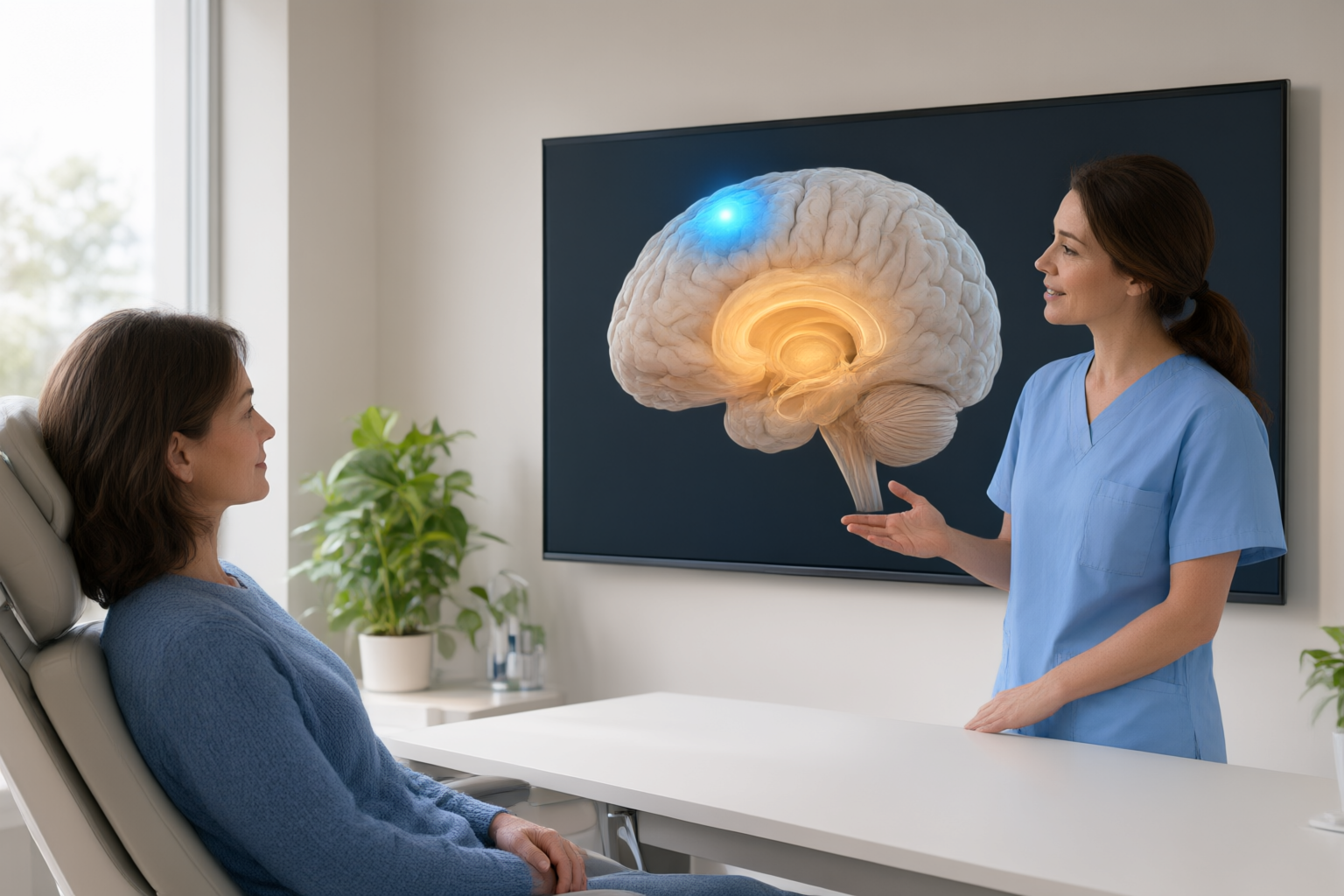
Repetitive transcranial magnetic stimulation (rTMS) is a noninvasive therapy that uses an electromagnet to deliver repeated low-intensity magnetic pulses to targeted brain areas. Unlike electroconvulsive therapy (ECT), rTMS does not intentionally induce a seizure. The magnetic field is turned on and off very rapidly, inducing weak electrical currents that stimulate neurons and neural circuits in the brain. According to the National Institute of Mental Health (NIMH), rTMS is FDA-cleared for treatment-resistant depression, obsessive-compulsive disorder (OCD), migraines, anxiety with depression, and smoking dependence. It is not approved for youth under 15 years old. A typical rTMS session usually lasts anywhere from 3 to 40 minutes, and a typical course consists of daily sessions 5 days per week for 4 to 6 weeks. Accelerated protocols that deliver multiple sessions per day over a shorter period are also available. Protocols vary by device, indication, and individual plan. This is general education, not a recommendation for any individual.[source]
What Is Deep TMS?
Deep TMS is a form of TMS that uses a different coil design. According to NIMH, in deep TMS, two coils may be used to deliver more stimulation to the region and target larger structures deep in the brain. The NIMH physics presentation categorizes Deep TMS coils, such as the H coils, as circular-type coils that produce a circular field pattern. In contrast, standard figure-eight coils are generally more focal. Coil design affects both the depth and the focality of stimulation. The deeper you stimulate, the more brain tissue is typically stimulated—a principle known as the focality-depth trade-off. Deep TMS is not necessarily superior to standard TMS; coil design differs, and readers should ask their clinic which coil is used.[source][source]
Deep TMS vs Standard TMS: Key Differences at a Glance
The table below summarizes key differences in coil design, focality, depth of stimulation, and typical protocol based on NIMH descriptions. Note that there is no consensus on the best coil placement or delivery method, and protocols vary by device, indication, and individual plan. This comparison does not rank one type as superior or compare outcomes.[source][source]
| Feature | Standard TMS (rTMS) | Deep TMS |
|---|---|---|
| Coil design | Figure-eight coil | May use two coils; categorized as circular-type (H-coil) |
| Focality | Generally more focal | Circular field pattern; less focal than figure-eight |
| Depth of stimulation | Penetrates about 2–3 cm from head surface | Targets larger structures deep in the brain |
| Typical session length | 3–40 minutes | Varies by protocol |
| Typical course length | Daily sessions 5 days/week for 4–6 weeks | Varies by protocol |
Why Protocol Details Matter for Patients
NIMH states there is not consensus on the best way to position the coil or deliver the electromagnetic pulses. Research is ongoing to establish the optimal brain sites to target and the best follow-up approach to sustain clinical improvement. The NIMH physics presentation describes variability in coil placement methods, including the 5-cm rule, EEG F3 localization, and MRI targeting. In some studies, the 5-cm rule may underdose the target compared with MRI or EEG methods. Patients should ask which coil and targeting method their clinic uses, and how session length and course length are determined. No method guarantees better outcomes.[source][source]
Safety and Side Effects: What Authoritative Sources Say
According to NIMH, overall rTMS is safe and well tolerated, but side effects can include discomfort at the magnet site, contraction or tingling of scalp, jaw, or face muscles, mild headache, brief lightheadedness, and dizziness. Seizures are possible, but a comprehensive review found that the risk is low. Long-term side effects have not been determined. Safety depends on individual factors and expert guidelines. A TMS evaluation assesses seizure and neurologic history, medications, sleep, and metal or implanted-device history. TMS is not risk-free and is not appropriate for everyone.[source]
Questions to Ask During a TMS Evaluation
Use the following questions to guide a discussion with a clinic. They are grounded in the evidence gaps and protocol variability described by NIMH. The website quiz can support discussion but cannot diagnose a condition. TMS is not appropriate for everyone, and this article does not provide individualized treatment recommendations.[source][source]
Questions to ask your clinic
- Which coil type does this clinic use? Ask whether the clinic uses a figure-eight coil (standard TMS) or an H-coil (Deep TMS).
- How is the coil positioned? Ask whether targeting uses the 5-cm rule, EEG F3 localization, or MRI guidance.
- What is the typical session length and course length for my protocol? Session length can range from 3 to 40 minutes, and a typical course is daily sessions 5 days per week for 4 to 6 weeks, but protocols vary.
- How will you screen for seizure risk and metal implants? A TMS evaluation assesses seizure and neurologic history, medications, sleep, and metal or implanted-device history.
- What follow-up or maintenance options exist? Ask about follow-up approaches to sustain clinical improvement, as research is ongoing to determine the best approach.
Frequently Asked Questions
Is Deep TMS better than standard TMS?
Supplied authoritative sources do not establish that one coil type is superior for all patients. NIMH notes there is no consensus on the best coil placement or delivery method, and outcomes depend on individual factors and protocol. Ask your clinic which coil is used and why.
Does Deep TMS go deeper into the brain than standard TMS?
NIMH describes deep TMS as using two coils to deliver more stimulation to the region and target larger structures deep in the brain. However, the NIMH physics presentation notes a depth-focality trade-off: deeper stimulation generally means more brain tissue is stimulated. This does not establish a clinical advantage.
How long does a TMS session take?
According to NIMH, a typical rTMS session usually lasts anywhere from 3 to 40 minutes, and a typical course is daily sessions 5 days per week for 4 to 6 weeks. Accelerated protocols may deliver multiple sessions per day over a shorter period. Exact timing varies by device, indication, and individual plan.
Is TMS safe?
NIMH describes rTMS as overall safe and well tolerated, with common side effects including scalp discomfort, muscle tingling, mild headache, and dizziness. Seizures are possible but the risk is low per a comprehensive review. Long-term side effects are not fully determined. Safety depends on individual screening; TMS is not risk-free.
Can I choose which type of TMS I receive?
Coil type and protocol are typically determined by the clinic based on device availability, your condition, and clinical judgment. You can ask which coil is used and how targeting is performed. This article does not provide individualized treatment recommendations.




Leave a Reply